Elevating Digital Narratives: The Strategic Value of the 100 Art Icons Set, Isometric 3d Style
In an era where digital attention spans are shrinking and visual competition is at an all-time high, the ability to communicate complex ideas instantly has become a critical asset for professionals across every sector. From tech startups pitching their next big idea to established enterprises rebranding their digital presence, the demand for high-fidelity, engaging visuals has never been greater. This shift has propelled three-dimensional design elements from niche artistic experiments into mainstream business strategy. At the forefront of this movement is the 100 Art Icons Set, Isometric 3d Style, a comprehensive collection designed to bridge the gap between technical precision and creative storytelling.
This specific icon set represents more than just a bundle of graphics; it embodies a response to the evolving expectations of modern consumers who crave depth, realism, and tactile engagement in their digital experiences. As we navigate a landscape dominated by flat design fatigue, the return to isometric and 3D aesthetics offers a fresh perspective that commands attention without sacrificing clarity. For creators, entrepreneurs, and marketers, understanding the utility of these assets is essential for maintaining a competitive edge in a saturated market.
The Renaissance of Isometric Design in Professional Contexts
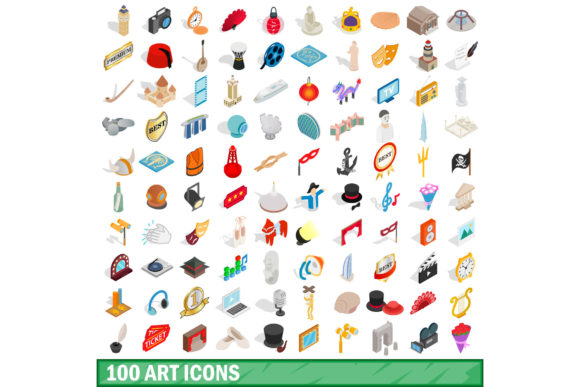
Isometric design, characterized by its unique projection that allows objects to be drawn in three dimensions without vanishing points, has undergone a significant transformation. While it was once primarily associated with technical schematics and architectural blueprints, today it serves as a powerful narrative tool. The 100 Art Icons Set, Isometric 3d Style capitalizes on this evolution by offering a curated selection of art-themed icons that possess both structural integrity and aesthetic appeal.
Why is this style gaining such traction among industry leaders? The answer lies in cognitive psychology. Human brains are wired to recognize patterns and spatial relationships. When presented with a flat, two-dimensional icon, the brain must work harder to infer context. However, an isometric representation provides immediate depth cues, allowing users to understand the function or concept of an icon almost instantaneously. This reduces cognitive load, making interfaces more intuitive and user-friendly. In a business context, this translates to higher conversion rates, lower bounce rates, and improved user retention.
Furthermore, the "art" theme within this specific set adds a layer of cultural sophistication. By focusing on artistic tools, canvases, brushes, and creative processes, the set resonates deeply with the growing "creator economy." It speaks directly to the identity of freelancers, designers, and content creators who view their work not merely as a service but as an art form. Integrating these icons into marketing materials signals to the audience that the brand values creativity, innovation, and craftsmanship.
Bridging the Gap Between Technology and Lifestyle
The relevance of the 100 Art Icons Set, Isometric 3d Style extends beyond mere decoration; it reflects a broader convergence of technology and lifestyle trends. We are witnessing a period where digital tools are becoming indistinguishable from physical ones. The rise of augmented reality (AR), virtual reality (VR), and immersive web experiences demands assets that can exist comfortably in 3D spaces. Traditional flat icons often look out of place in these environments, appearing as if they are floating on top of the interface rather than integrated into it.
For professionals developing mobile applications, SaaS platforms, or educational software, the need for versatile, scalable assets is paramount. This icon set addresses those needs by providing vectors that maintain their quality regardless of scale. Whether used as a small navigation element on a smartphone screen or as a large hero image on a landing page, the isometric depth ensures the graphic remains legible and impactful. This versatility is crucial for brands operating across multiple touchpoints, ensuring a cohesive visual language that reinforces brand identity.
Moreover, the trend towards "gamification" in non-gaming sectors has accelerated the adoption of 3D styles. Companies are increasingly using game-like mechanics to drive engagement, reward user behavior, and simplify learning curves. The playful yet structured nature of isometric art aligns perfectly with this objective. When a financial app uses an isometric piggy bank or a project management tool displays a 3D checklist, the interaction feels less like a chore and more like an engaging experience. The 100 Art Icons Set provides the necessary building blocks to create these immersive environments effectively.
Workflow Efficiency and Technical Flexibility
For the modern designer and developer, time is the most valuable currency. The efficiency of a workflow often determines the success of a project, and having access to high-quality, pre-optimized assets can significantly reduce production time. The 100 Art Icons Set, Isometric 3d Style is engineered with practicality in mind, offering compatibility across a wide range of professional formats including JPG, EPS, AI, PSD, and PNG.
- Vector Formats (EPS, AI): These files are indispensable for print media and large-scale digital displays. They allow designers to scale the icons to billboard size without any loss of resolution, ensuring crisp edges and vibrant colors. The editable nature of vector paths also enables customization, allowing teams to tweak colors to match specific brand guidelines or adjust lighting effects to suit different moods.
- Raster Formats (JPG, PNG): For web developers and social media managers, rasterized versions offer immediate usability. High-resolution PNGs with transparent backgrounds can be dropped directly into HTML/CSS projects or social media posts, eliminating the need for background removal or complex editing. This immediacy is vital for agile marketing teams that need to pivot strategies quickly.
- Layered Files (PSD): The inclusion of Photoshop files caters to the needs of graphic artists who require granular control over individual elements. Layers allow for complex compositing, enabling the creation of unique scenes where art icons interact with other design elements seamlessly.
This multi-format approach eliminates the friction often found in asset management. Instead of hunting for specific file types or converting files manually (which can degrade quality), professionals have a single source of truth that adapts to their specific requirements. This flexibility supports diverse workflows, from rapid prototyping in Figma to finalizing print-ready brochures in Adobe Illustrator.
Practical Applications Across Industries
The utility of this icon set is vast, transcending the boundaries of the art world itself. Consider the education sector, where e-learning platforms are constantly seeking ways to make complex subjects more accessible. An isometric set featuring art supplies can be used to visualize modules in a digital art course, making the curriculum feel tangible and inviting.
In the corporate world, internal communication tools benefit immensely from these visuals. A company culture deck that uses 3D icons to represent values like "Creativity," "Collaboration," and "Innovation" will resonate more strongly with employees than text-heavy slides. The visual metaphor of a paintbrush or a palette becomes a symbol of the company's commitment to artistic excellence and forward-thinking.
Even in the realm of e-commerce, the impact is notable. Online stores selling art supplies, craft kits, or creative courses can leverage these icons to enhance product categorization. Instead of generic folder icons, a store could use an isometric easel to denote painting supplies or a 3D camera to represent photography gear. This level of detail enhances the shopping experience, helping customers navigate the site with confidence and enjoyment.
Future-Proofing Your Visual Strategy
As we look toward the future of digital design, one thing is certain: static, monochromatic interfaces will continue to give way to dynamic, interactive, and spatially aware experiences. The 100 Art Icons Set, Isometric 3d Style positions professionals at the forefront of this transition. By adopting these assets now, businesses are not just solving current design challenges; they are laying the groundwork for future innovations.
The integration of 3D elements into web design is no longer a futuristic concept but a present-day reality. With the increasing power of web browsers and devices, rendering 3D graphics in real-time is becoming standard practice. Having a library of high-quality 3D-style icons ensures that when a brand decides to implement WebGL or Three.js animations, they already have the foundational assets ready to go. This preparedness can be the difference between a lagging competitor and a market leader.
Furthermore, the emphasis on "helpful content" and user-centric design means that visuals must serve a purpose. The 100 Art Icons Set adheres to this principle by providing clear, recognizable symbols that enhance comprehension rather than cluttering the interface. In a world flooded with information, clarity is the ultimate luxury. By choosing icons that are both aesthetically pleasing and functionally robust, professionals ensure that their message is received loud and clear.
Conclusion: A Tool for Creative Excellence
The decision to incorporate the 100 Art Icons Set, Isometric 3d Style into your design toolkit is a strategic move that aligns with the trajectory of modern digital communication. It acknowledges the shifting preferences of audiences who seek depth and engagement, while simultaneously addressing the practical needs of creators who require efficiency and versatility. Whether you are a freelancer crafting a personal portfolio, a marketer launching a new campaign, or a developer building the next generation of apps, these icons provide the visual vocabulary needed to tell compelling stories.
In a landscape defined by constant change, the ability to adapt and evolve is key. This icon set offers a stable foundation upon which innovative designs can be built. It bridges the gap between traditional artistry and cutting-edge technology, creating a harmonious blend that appeals to both the eye and the mind. As the digital ecosystem continues to mature, the value of high-quality, context-aware visual assets will only increase. Embracing the 100 Art Icons Set, Isometric 3d Style is not just about updating a design; it is about investing in the future of your brand's visual identity.
For those ready to elevate their projects, the availability of these assets in multiple formats ensures that there is no barrier to entry. From the initial sketch to the final deployment, the journey is streamlined, allowing creativity to flourish without technical constraints. In the end, the goal of any design professional is to create meaningful connections, and sometimes, the most effective way to do so is through the simple yet profound power of a well-crafted, three-dimensional icon.