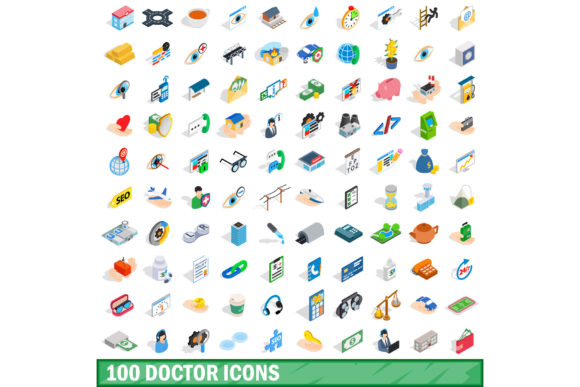
100 Doctor Icons Set, Isometric 3d Style: Elevating Digital Health Visuals
In the rapidly evolving landscape of digital design, visual clarity is no longer just an aesthetic choice; it is a critical component of communication. As we navigate an era where information overload is constant, the ability to convey complex medical concepts quickly and intuitively has become paramount. This is where the 100 Doctor Icons Set, Isometric 3d Style emerges as a transformative resource for creators across the spectrum. Moving beyond the flat, two-dimensional limitations of traditional iconography, this collection offers a depth and realism that resonates with modern user expectations.
The shift towards three-dimensional representations in user interfaces and marketing materials reflects a broader trend in how audiences consume content. People are drawn to visuals that feel tangible and immersive. An isometric view provides a perfect balance between technical precision and artistic appeal, allowing designers to create a sense of space without the distortion of perspective. For professionals designing healthcare apps, educational platforms, or corporate presentations, having access to a comprehensive library like the 100 doctor icons set in isometric 3d style ensures that every interaction feels polished and professional.
Why Isometric Design Dominates Modern Healthcare Visualization
Understanding the value of this specific icon set requires looking at the psychology of visual perception. Isometric illustrations have gained significant traction because they offer a "technical yet friendly" look. Unlike photorealistic images which can sometimes feel cold or clinical, isometric art retains a stylized charm while maintaining structural accuracy. This makes it ideal for explaining medical procedures, showing hospital layouts, or representing various roles within the healthcare system.
The 100 Doctor Icons Set, Isometric 3d Style leverages this aesthetic to break down barriers in health communication. When a user encounters a flat icon of a stethoscope, their brain processes it as a symbol. However, when presented with an isometric rendering that shows the texture of the rubber, the metallic sheen of the chest piece, and the depth of the earpieces, the object becomes familiar and trustworthy. This subtle psychological shift is crucial for building confidence in digital health products.
Furthermore, the versatility of isometric design allows for scalability. Whether these icons are used as tiny navigation buttons on a mobile app or as large hero graphics on a landing page, they maintain their integrity. The 3D effect adds a layer of sophistication that elevates the perceived value of the project. For entrepreneurs launching health-tech startups, using high-quality, consistent imagery is often the difference between being overlooked and standing out in a crowded marketplace.
A Comprehensive Toolkit for Diverse Creative Needs
One of the most compelling aspects of this collection is its sheer comprehensiveness. The 100 doctor icons set in isometric 3d style for any design vector illustration covers a vast array of scenarios relevant to the medical field. It is not merely a pack of generic symbols; it is a curated exploration of the healthcare ecosystem. From doctors in various specializations like cardiology and pediatrics to nurses, surgeons, and administrative staff, the set captures the human element of medicine.
But the utility extends beyond just people. The set likely includes equipment, pharmaceutical items, diagnostic tools, and symbolic representations of health concepts like heart rate monitoring, vaccination, and telemedicine. This breadth allows designers to tell a complete story without needing to source assets from multiple vendors. Consistency in style is the hallmark of professional design, and a unified set ensures that a brochure, a website, and a social media campaign all speak the same visual language.
For freelancers and agencies managing tight deadlines, this efficiency is invaluable. Instead of spending hours modeling individual 3D elements or searching for compatible clip art, they can assemble high-quality compositions instantly. The inclusion of such a wide variety of subjects means that whether a client needs to illustrate a rare genetic condition or a routine check-up, there is likely a pre-designed asset ready to be adapted.
Technical Flexibility Across Formats
Design work rarely happens in a vacuum; it involves a complex workflow that moves between different software applications and output requirements. The availability of the 100 Doctor Icons Set, Isometric 3d Style in multiple formats—JPG, EPS, AI, PSD, PNG—addresses this reality head-on. Each format serves a specific purpose in the production pipeline, ensuring that the designer has the right tool for every job.
- AI and EPS (Vector): These formats are essential for print design and large-scale graphics. Vector files allow for infinite scaling without loss of quality. A logo or a billboard featuring these icons can be resized from a business card to a skyscraper wrap without pixelation. This is particularly important for medical institutions that require crisp branding materials.
- PSD (Photoshop): For designers who need to apply advanced lighting effects, shadows, or composite the icons into complex scenes, the PSD format provides layers. This editability is crucial for customizing the look and feel to match a specific brand identity or campaign theme.
- PNG (Raster): With transparent backgrounds, PNG files are the go-to solution for web development and UI/UX design. They integrate seamlessly into websites and mobile applications, ensuring that the icons look sharp on Retina displays and various screen sizes.
- JPG: While less common for editing, JPGs are useful for quick previews or when file size is a primary concern for email attachments and certain web contexts where transparency isn't required.
This multi-format approach eliminates the friction often found in creative projects. There is no need for time-consuming conversion processes that can degrade image quality. The flexibility empowers users to adapt the 100 doctor icons set in isometric 3d style to virtually any medium, from printed brochures to interactive digital dashboards.
Meeting the Demands of Modern Workflows
The relevance of this icon set is further amplified by the changing habits of our audience. In the post-pandemic world, digital health solutions have moved from being a luxury to a necessity. Telehealth consultations, remote patient monitoring, and online appointment scheduling are now standard practices. Consequently, the demand for high-quality visual assets that represent these services accurately has skyrocketed.
Marketers and educators are increasingly relying on visual storytelling to explain complex topics. A static text description of a surgical procedure or a new vaccine protocol is often insufficient. Dynamic, 3D visuals help demystify these subjects, making them accessible to patients and students alike. The 100 Doctor Icons Set, Isometric 3d Style supports this educational shift by providing clear, engaging graphics that can simplify the complex.
Moreover, the trend towards personalized user experiences in software design favors unique assets over generic stock photos. Businesses are seeking ways to differentiate their brands, and custom iconography plays a pivotal role in this strategy. By utilizing a specialized set like this, companies can create a distinctive visual identity that feels tailored to their specific niche within the healthcare sector.
Practical Applications for Professionals and Hobbyists
The utility of this collection spans a wide range of users. For business owners in the medical industry, these icons can enhance pitch decks, investor presentations, and internal training materials. They add a layer of professionalism that can influence decision-making and stakeholder confidence.
Educators and bloggers can use these visuals to create engaging course materials, blog posts, and infographics. The isometric style lends itself well to creating diagrams that explain anatomical structures or medical workflows in an easy-to-digest format. For freelancers, having a diverse portfolio of high-quality assets allows them to take on more varied projects, from app design to editorial illustration.
Even hobbyists and curious readers interested in graphic design can find value here. Learning to manipulate 3D-style vectors in software like Illustrator or Photoshop provides excellent practice in understanding depth, lighting, and composition. The set serves as both a functional tool and a learning resource.
Looking Ahead: The Future of Medical Graphics
As technology continues to advance, the line between virtual and physical realities blurs. Augmented Reality (AR) and Virtual Reality (VR) are beginning to play significant roles in medical training and patient education. The principles behind isometric design—clarity, dimensionality, and spatial awareness—are foundational for these emerging technologies.
Investing in high-quality, versatile assets today prepares creators for tomorrow's challenges. The 100 doctor icons set in isometric 3d style for any design vector illustration is not just a collection of images; it is a forward-looking investment in visual communication. It acknowledges that the future of healthcare design is immersive, interactive, and deeply human-centric.
By choosing a resource that prioritizes quality, variety, and technical flexibility, professionals ensure that their work remains relevant and effective. In a world where attention is scarce, the ability to capture interest through superior design is a competitive advantage. The 100 Doctor Icons Set, Isometric 3d Style stands as a testament to the power of thoughtful design in shaping how we understand and interact with the vital world of healthcare.