Enhancing Visual Communication with the 100 Retail Sales Icons Set, Isometric 3d
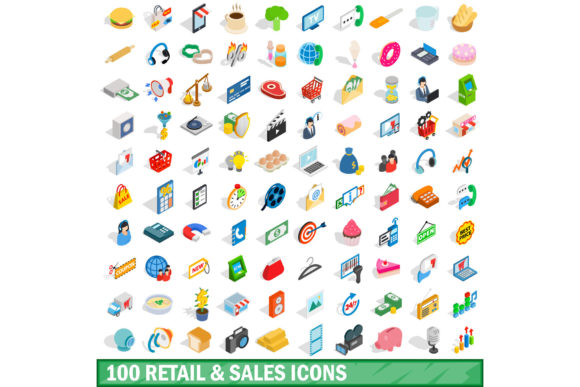
In the rapidly evolving landscape of digital marketing and graphic design, visual clarity often dictates user engagement. The human brain processes images significantly faster than text, making high-quality graphics essential for conveying complex information in a digestible format. This is where specialized asset libraries become invaluable tools for professionals across various sectors. Specifically, the 100 Retail Sales Icons Set, Isometric 3d represents a significant leap forward in how businesses visualize commerce, inventory, and customer interaction. By combining the depth of three-dimensional rendering with the clean geometry of isometric projection, this collection offers a unique aesthetic that stands out in crowded digital marketplaces.
The transition from flat, two-dimensional vector art to volumetric, isometric illustrations has been a major trend in modern UI/UX design. Flat icons are efficient, but they can sometimes lack the tactile feel required to evoke trust or excitement in a retail environment. The 100 retail sales icons set in isometric 3d style addresses this by providing assets that appear tangible and robust. Whether you are designing a dashboard for an e-commerce platform, creating a presentation for investors, or developing educational materials for business students, these icons provide a level of sophistication that elevates the entire project.
The Power of Isometric Geometry in Commercial Design
To understand the value of this specific icon set, one must first appreciate the technical advantages of isometric projection. Unlike perspective drawing, which uses vanishing points to create a realistic sense of depth, isometric projection maintains parallel lines throughout the image. This creates a consistent scale where objects do not appear to get smaller as they recede into the background. For data visualization and interface design, this consistency is paramount because it prevents distortion and ensures that all elements remain legible regardless of their position on the screen.
When applied to retail scenarios, this geometric precision allows designers to represent complex systems clearly. A standard shopping cart icon might be simple, but an isometric version can show items inside, a receipt attached, and a price tag floating nearby, all without cluttering the visual field. The 100 Retail Sales Icons Set, Isometric 3d leverages this property to create a cohesive library where every element—from cash registers to delivery trucks—shares the same spatial logic. This uniformity is crucial when building multi-page websites or comprehensive infographics, as it eliminates the jarring effect of mixing different artistic styles.
The "3d" aspect of these icons does not rely on heavy textures or photorealistic lighting that would slow down web performance. Instead, it utilizes subtle gradients and shading techniques to simulate volume. This results in lightweight files that render instantly while still offering the premium look associated with high-end illustration software. For developers working on mobile applications where bandwidth and load times are critical constraints, this balance between aesthetic richness and technical efficiency is a game-changer.
Key Characteristics of the Collection
- Geometric Consistency: All 100 icons adhere to a strict isometric grid, ensuring they align perfectly when placed together in a layout.
- Volumetric Depth: The use of simulated lighting and shadows gives each object a physical presence, enhancing user immersion.
- Scalability: As vector-based assets, these icons can be resized from a favicon to a billboard without any loss of quality.
- Thematic Variety: The set covers the entire retail spectrum, including point-of-sale transactions, logistics, customer service, and inventory management.
Diverse Applications Across Industries
The versatility of the 100 retail sales icons set in isometric 3d style extends far beyond simple e-commerce websites. Professionals in education, corporate strategy, and public relations utilize these assets to communicate abstract concepts in a concrete manner. Because the icons depict recognizable real-world objects through a stylized lens, they bridge the gap between technical data and human understanding.
In the realm of e-learning and education, instructors often struggle to keep students engaged with dry financial or logistical data. Using isometric icons to illustrate supply chain flows, profit margins, or customer journey maps transforms boring charts into engaging visual stories. Students can immediately grasp the relationship between a warehouse, a truck, and a storefront simply by looking at the connected icons. This visual shorthand accelerates learning and retention, making complex business models easier to digest.
For business owners and entrepreneurs, these icons serve as powerful tools in pitch decks and investor presentations. Investors are bombarded with text-heavy slides; a slide deck that features a dynamic, isometric representation of a business model is far more likely to capture attention. Imagine presenting a growth strategy where the icons visually grow or connect to show expansion. The 100 Retail Sales Icons Set, Isometric 3d provides the necessary components to build these narratives without requiring expensive custom illustration services.
Even in the healthcare and non-profit sectors, these assets find relevance. Hospitals managing inventory for medical supplies or non-profits tracking donation logistics can benefit from the clear, organized nature of isometric diagrams. The neutral yet professional aesthetic of the set ensures it fits seamlessly into branding guidelines for organizations that need to convey reliability and efficiency.
Workflow Integration for Creators
Designers and developers face the challenge of integrating diverse assets into a cohesive workflow. The availability of the 100 retail sales icons set, Isometric 3d in multiple formats—JPG, EPS, AI, PSD, PNG—ensures compatibility with virtually any software stack. This flexibility allows teams to choose the optimal file type based on their specific stage in the production process.
- Conceptualization (EPS/AI): During the initial brainstorming phase, vector formats like EPS and AI allow for unlimited manipulation. Designers can change colors, resize elements, or combine shapes to create custom variations that fit the brand identity perfectly.
- Mockup and Prototyping (PSD): When moving to high-fidelity mockups, the PSD format preserves layers. This enables UI/UX designers to adjust individual components, such as the shadow intensity or the color of a shopping bag, without rebuilding the entire icon.
- Web and Mobile Deployment (PNG/JPG): For final implementation, raster formats like PNG offer transparency support, while JPGs provide optimized file sizes for backgrounds. These formats ensure that the final product loads quickly on all devices.
This multi-format approach eliminates the friction often found in creative projects where assets need to be converted back and forth between software. It streamlines the handoff between designers and developers, reducing the time spent on technical adjustments and allowing more focus on creative problem-solving.
Strategic Considerations for Implementation
While the benefits of using isometric 3d icons are clear, successful implementation requires thoughtful consideration of context and usability. The primary goal of any visual asset is to enhance communication, not distract from it. Therefore, designers must ensure that the complexity of the isometric style does not obscure the intended message.
Color Harmony is another critical factor. Isometric icons rely heavily on shading to define their shape. If the base colors are too dark or too bright, the depth effects may be lost or become overwhelming. It is advisable to select a color palette that complements the natural shading of the icons rather than fighting against it. Many users of the 100 retail sales icons set in isometric 3d style find success by using muted, professional tones for the main interface and reserving vibrant colors for call-to-action elements.
Accessibility should never be an afterthought. While 3d icons are visually appealing, they must still convey meaning to users who rely on screen readers or have low vision. This means pairing the icons with descriptive alt text and ensuring that the color contrast meets WCAG standards. The visual depth of the icons adds a layer of interest, but the underlying semantic meaning must remain accessible to all users.
Furthermore, consistency in scale and proportion is vital. In a mixed media project, an isometric icon might look out of place next to a flat line icon or a photograph. To maintain a professional appearance, designers should commit to a single visual language. If the project begins with the 100 Retail Sales Icons Set, Isometric 3d, all subsequent graphical elements should ideally match that isometric perspective and depth.
Future Trends in Retail Visualization
The retail industry is constantly adapting to new technologies, and visual communication must evolve alongside it. We are seeing a shift towards immersive experiences, augmented reality (AR), and virtual try-ons. Isometric 3d graphics serve as a foundational step toward these advanced interactions. They provide a familiar, grounded representation of products and environments that can easily be transitioned into fully interactive 3D models.
As consumers become more accustomed to rich, interactive interfaces, the demand for high-quality, dynamic visuals will only increase. Static flat icons may eventually feel outdated in premium retail experiences. The 100 retail sales icons set in isometric 3d style positions brands at the forefront of this evolution, offering assets that feel modern and forward-thinking. By adopting these tools now, businesses can future-proof their visual identity and stay competitive in a saturated market.
Maximizing Value Through Versatility
The true strength of this icon set lies in its ability to adapt to different needs without losing its core identity. Whether used as a standalone graphic in a blog post, a functional button in an app, or a decorative element in a brochure, the icons maintain their integrity. This adaptability reduces the need for purchasing multiple asset packs, saving both time and budget for creators.
For researchers studying consumer behavior, these icons can be used to map out decision trees and customer pathways. The visual distinction between different stages of the retail cycle—awareness, consideration, purchase, and retention—is made clearer through the distinct imagery provided in the set. This helps in creating reports and papers that are not only informative but also visually compelling.
Hobbyists and independent creators also benefit from this resource. With the rise of content creation and personal branding, individuals need access to professional-grade tools. The 100 Retail Sales Icons Set, Isometric 3d democratizes access to high-quality design elements, allowing solo entrepreneurs to produce work that rivals large agencies. The inclusion of source files like AI and PSD empowers users to modify the icons to suit their unique visions, fostering creativity and innovation.
In conclusion, the integration of isometric 3d graphics into retail and business communications represents a significant advancement in visual design. The 100 Retail Sales Icons Set, Isometric 3d offers a comprehensive, flexible, and aesthetically pleasing solution for anyone looking to elevate their visual storytelling. By understanding the technical advantages of isometry, exploring diverse application scenarios, and adhering to best practices in accessibility and design, professionals can harness the full potential of these assets. As the digital world continues to prioritize user experience and visual engagement, having a robust library of high-quality icons becomes not just a luxury, but a necessity for effective communication.