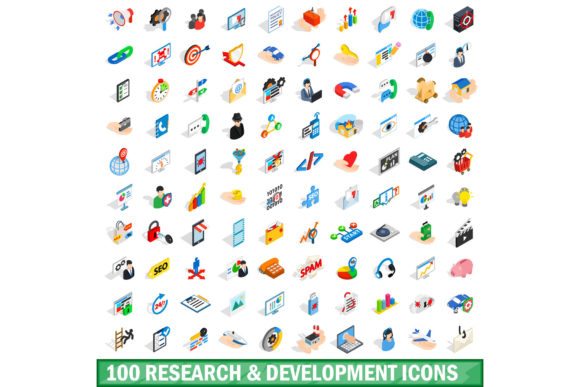
100 Research Development Icons Set for Design
Visual communication is the backbone of modern information sharing, yet finding the right imagery to represent complex scientific and academic concepts can be a frustrating hurdle. The 100 Research Development Icons Set offers a comprehensive solution designed to bridge the gap between abstract data and clear visual storytelling. This collection features 100 research development icons set in an isometric 3D style, providing depth and dimension that flat illustrations often lack. Whether you are crafting a presentation for a boardroom or creating educational materials for a classroom, having access to high-quality vector graphics can significantly elevate the perceived value of your work.
The isometric 3D style is particularly effective because it creates a sense of structure and precision. Unlike standard 2D icons which can sometimes feel generic, these three-dimensional elements suggest a tangible process, making them ideal for illustrating steps in a methodology, the layers of a database, or the progression of a scientific experiment. By offering formats such as JPG, EPS, AI, PSD, and PNG, this resource ensures compatibility across various software environments, allowing users to integrate these assets seamlessly into their existing workflows without technical friction.
Why Different Audiences Value Visual Assets Differently
While the core functionality of the icon set remains the same, the way different professionals utilize and evaluate these assets varies widely based on their specific goals and constraints. For a beginner just starting out in graphic design, the primary concern is often ease of use and learning potential. They might appreciate the included PSD files because they allow for layer manipulation, providing an opportunity to deconstruct how the isometric perspective was achieved. In contrast, an experienced user prioritizes flexibility and non-destructive editing, relying heavily on the EPS and AI vector formats to scale images up to billboard size without losing clarity.
For entrepreneurs and small business owners, the decision often hinges on commercial value and time efficiency. These individuals need to produce professional marketing materials quickly to compete with larger corporations. The 100 Research Development Icons Set serves as a cost-effective alternative to hiring a custom illustrator for every project. Instead of spending weeks waiting for bespoke artwork, a startup founder can download the set, customize the colors to match their brand guidelines, and immediately apply the icons to pitch decks or website headers. The speed of deployment here directly correlates to the ability to capture market attention before competitors do.
Educators and academics view these icons through the lens of clarity and engagement. When explaining complex research methodologies to students, static text can be overwhelming. Isometric 3D icons break down these barriers by turning abstract concepts like "data analysis" or "peer review" into relatable visual metaphors. A teacher might use a single icon from the set to anchor a lecture slide, helping learners visualize the flow of information. For this group, the reliability of the design is paramount; the icons must look consistent and professional to maintain credibility within the academic community.
Practical Applications Across Industries
The versatility of the set extends far beyond simple decoration. Consider a freelancer managing multiple client accounts. One week they might be designing a brochure for a biotech firm, requiring precise representations of DNA sequencing or laboratory equipment. The next week, they could be working on a fintech app that needs to illustrate algorithmic trading or cloud storage security. Having a unified set of 100 icons ensures a consistent visual language across diverse projects, saving the freelancer from constantly searching for new assets that might clash stylistically.
Bloggers and content creators also benefit significantly from this resource. Search engines favor content that includes relevant, high-quality visuals. An article about the future of artificial intelligence becomes much more engaging when accompanied by isometric icons depicting neural networks or machine learning processes. The inclusion of PNG files with transparent backgrounds allows these creators to place the icons directly over colorful blog backgrounds or within infographics without needing advanced photo editing skills. This accessibility empowers hobbyists and independent publishers to produce content that rivals professional publications.
Marketers looking to improve conversion rates understand that users scan content rather than reading it word-for-word. Icons act as visual anchors that guide the eye and reinforce key messages. A campaign promoting a new research tool can use the 100 Research Development Icons Set to create a cohesive visual narrative. By using the isometric style, the marketing materials stand out against the typical flat design trends, capturing the viewer's attention in a crowded digital landscape. The variety of formats ensures that these assets can be deployed effectively on social media platforms, email newsletters, and printed collateral alike.
Evaluating Quality and Long-Term Usefulness
When selecting a design asset, it is crucial to consider not just the immediate aesthetic appeal but also the long-term usefulness of the file formats provided. The availability of both raster (JPG, PNG) and vector (EPS, AI, PSD) formats is a significant advantage. Vector formats allow for infinite scaling, meaning an icon used in a mobile app notification can be resized for a large conference banner without pixelation. This flexibility protects the investment, ensuring that the icons remain useful as projects grow in scope or change in medium.
Furthermore, the isometric 3D style offers a timeless quality that tends to age better than fleeting design trends. While flat design has been popular for years, the slight depth added by isometric projection adds a layer of sophistication that feels modern yet established. This makes the 100 Research Development Icons Set a sustainable choice for businesses planning to build a long-term brand identity. It reduces the need for frequent redesigns simply because the visual style has become dated.
For those evaluating the set based on creativity, the variety within the 100-icon collection is essential. A good icon set should cover a broad spectrum of research activities, from initial hypothesis generation to final publication. Users should look for icons that represent distinct phases of the development cycle, including collaboration tools, data visualization, hardware, and theoretical frameworks. The ability to mix and match these elements allows designers to construct unique scenes that tell a specific story, rather than being limited to a repetitive pattern of identical symbols.
Making the Right Choice for Your Project
Ultimately, deciding whether this set fits your needs depends on your specific requirements for quality, format, and thematic relevance. If you are working on a project that demands high-fidelity 3D rendering and requires the ability to edit individual layers, the inclusion of PSD and AI files is a strong indicator of value. Conversely, if your workflow is strictly web-based and requires lightweight images, the JPG and PNG options provide immediate utility without the overhead of heavy vector files.
By understanding how these icons serve different purposes—from aiding a student's comprehension to driving a corporation's sales strategy—you can better appreciate the breadth of this collection. The 100 Research Development Icons Set is more than just a bundle of graphics; it is a toolkit designed to enhance communication across disciplines. Whether you are a seasoned designer seeking inspiration or a novice looking to add polish to your first presentation, the combination of isometric depth and versatile formatting provides a solid foundation for creating impactful visual content.