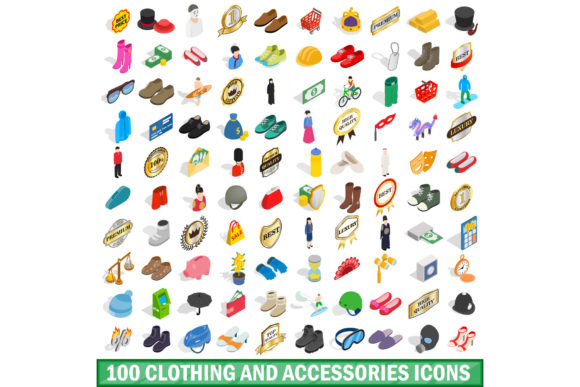
100 Clothing and Accessories Icons Set: A Practical Guide for Designers
In the competitive landscape of digital design, visual assets often determine the difference between a polished product and a generic one. For professionals working in e-commerce, fashion branding, or user interface design, the need for high-quality, versatile imagery is constant. The 100 Clothing and Accessories Icons Set addresses this demand by offering a comprehensive collection that bridges the gap between flat graphic design and modern three-dimensional aesthetics. This resource is not merely a bundle of images; it is a strategic toolkit designed to elevate projects ranging from mobile applications to print catalogs.
Understanding the specific value of this set requires looking beyond the sheer number of icons included. While many libraries offer thousands of low-resolution placeholders, this collection focuses on depth and variety. It provides two distinct stylistic approaches within a single package: standard vector illustrations and an exclusive isometric 3D style. This duality allows designers to maintain visual consistency across different mediums without needing to source assets from multiple vendors. Whether you are building a checkout flow for a clothing store or designing a marketing banner for a new accessory line, having access to both flat and dimensional representations ensures your project remains adaptable to current design trends.
Distinguishing Features of the Collection
The primary distinction of the 100 Clothing and Accessories Icons Set lies in its dual-format capability. In contemporary web and app design, flat icons remain popular for their clarity and speed of rendering. However, the trend has shifted significantly toward isometric and pseudo-3D graphics, which add depth, realism, and a sense of tactility to digital interfaces. By including 100 items in isometric 3D style alongside traditional vectors, this set caters to both conservative and experimental design strategies.
The collection covers a broad spectrum of categories essential for the fashion industry. You will find representations of everyday wear such as t-shirts, jeans, and dresses, alongside specialized items like hats, scarves, and jewelry. The inclusion of accessories is particularly valuable, as these small details often drive consumer engagement. From handbags and sunglasses to watches and belts, the granular detail in these icons helps create a more immersive shopping experience. Unlike generic clip art, these icons are crafted with attention to texture and form, making them suitable for high-stakes commercial use.
Format Versatility and Workflow Integration
A critical factor in selecting any asset library is the compatibility of file formats with existing workflows. This set excels in this area by supporting a wide array of professional standards, including JPG, EPS, AI, PSD, and PNG. The availability of native Adobe Illustrator (AI) and Photoshop (PSD) files is particularly beneficial for designers who require editable layers. This means you can recolor garments to match a brand's specific palette, adjust shadows in the 3D elements, or isolate specific parts of an icon without losing quality.
The inclusion of EPS files further extends the utility of this set into the realm of print media. Vector-based formats ensure that logos and illustrations remain crisp at any scale, whether printed on a business card or a large-scale billboard. Meanwhile, the PNG and JPG options provide ready-to-use raster files for quick deployment in web environments where editing is not required. This multi-format approach eliminates the need for conversion tools, saving time and reducing the risk of quality degradation during the export process.
Evaluating Strengths and Tradeoffs
When comparing the 100 Clothing and Accessories Icons Set against other resources, several strengths become apparent. The most significant advantage is the cohesive design language. In many alternative bundles, flat icons and 3D models may clash due to differing artistic styles or lighting conditions. Here, the consistent application of isometric perspective and shadowing creates a unified look that enhances brand identity. Furthermore, the curated nature of the set—containing exactly 100 items—prevents "analysis paralysis." Designers are not overwhelmed by thousands of irrelevant options but are presented with a focused selection of high-demand items.
However, no resource is without limitations, and understanding the tradeoffs is essential for informed decision-making. One potential constraint is the specific aesthetic of the isometric style. While highly effective for modern tech and lifestyle brands, this style may feel out of place in projects requiring a vintage, hand-drawn, or hyper-realistic photographic look. If a designer's project relies heavily on organic textures or photorealism, these vector-based icons might appear too stylized. Additionally, while the set offers extensive coverage of clothing and accessories, it does not include footwear or seasonal variations in the same depth as a dedicated shoe icon pack. Therefore, it serves best as a core asset library rather than a complete solution for every possible fashion-related query.
Comparison with Alternative Approaches
To make a fully informed choice, it is helpful to compare this set with other common methods of acquiring fashion imagery. The first alternative is using stock photography. While photos offer unmatched realism, they come with significant drawbacks regarding flexibility. Photos cannot be easily recolored, and scaling them up often results in pixelation. The 100 Clothing and Accessories Icons Set offers superior scalability and editability, allowing for dynamic customization that static images cannot match.
A second comparison point is custom illustration services. Hiring a freelancer to create unique icons ensures a perfect match for a brand's specific needs. However, this approach is cost-prohibitive for many projects and time-consuming to execute. For startups or rapid prototyping phases, purchasing a pre-made set like this one is a far more efficient strategy. It provides immediate value and allows teams to iterate quickly before investing in bespoke artwork. Conversely, if a brand has a highly unique identity that deviates from standard fashion tropes, a custom commission might eventually be necessary, but the icon set serves as an excellent starting point or placeholder.
Finally, consider the comparison with free icon libraries. While budget-friendly, free resources often suffer from inconsistent quality, mixed styles, and unclear licensing terms. The 100 Clothing and Accessories Icons Set distinguishes itself through professional curation and clear usage rights. The investment pays off in the reliability of the assets and the reduction of legal risks associated with improper attribution.
Best-Fit Scenarios and Decision Factors
So, when is this set the right choice? It is ideal for UI/UX designers building fashion e-commerce platforms, marketing teams creating social media campaigns, and developers launching mobile apps related to retail. The isometric 3D style is particularly well-suited for landing pages where capturing user attention is paramount. The flat versions work perfectly for navigation menus, filters, and informational diagrams where space is limited.
Conversely, readers should consider alternatives if their project demands a specific artistic niche not covered here, such as streetwear-specific graffiti styles or historical costume accuracy. If the workflow strictly requires 3D modeling software outputs (like .OBJ or .FBX files) for animation, this vector-based set would require conversion or supplementation. Similarly, if the design system relies entirely on monochrome outlines without color or shading, the detailed 3D aspect might be underutilized, though the vector base still supports such modifications.
Practical Application Examples
Imagine a scenario where a startup is launching a subscription box service for men's grooming and accessories. They need a website that feels premium yet accessible. Using the 100 Clothing and Accessories Icons Set, the design team can utilize the isometric 3D icons for the hero section to create a visually striking entrance. These icons can depict a watch, a wallet, and a leather jacket, instantly communicating the product category. As users scroll down to filter products, the team can switch to the flat vector versions for the category icons, ensuring the interface remains clean and readable.
Another practical example involves a seasonal sale campaign. Because the icons are available in editable AI and PSD formats, the marketing team can quickly change the colors of the shirts and jackets to reflect summer or winter palettes. They can also adjust the lighting on the 3D elements to simulate different times of day or moods. This level of control transforms a static asset into a dynamic marketing tool, extending the lifecycle of the purchase far beyond the initial download.
Making the Final Choice
Selecting the right visual assets is a balancing act between aesthetic appeal, technical requirements, and budget. The 100 Clothing and Accessories Icons Set stands out as a robust option for professionals seeking a blend of modern 3D aesthetics and traditional vector utility. Its strength lies in its versatility, offering formats that support both screen and print media while providing two distinct visual styles within one cohesive collection.
For those evaluating their options, the key takeaway is to assess the specific needs of the current project. If the goal is to create a modern, engaging digital experience that requires frequent updates and customization, this set provides the necessary foundation. It removes the friction of sourcing disparate assets and allows designers to focus on the creative strategy rather than the technical hunt for images. By understanding the strengths of this collection and recognizing where it fits within the broader ecosystem of design resources, professionals can make confident decisions that enhance the quality and impact of their work.